

UFE response to ACER consultation on prioritising the removal of barriers to electricity demand response
02 February 2024
Inscriptions et réservations en ligne sur le site dédié à cet événement annuel
Inscrivez-vous !UFE, the association representing the French Electricity industry, supports the proposal made by the European Commission for a new Regulation on the Alternative Fuels Infrastructure: it sends positive signals regarding the electrification of transport, a necessity to decarbonise this sector. Key provisions, that UFE and the electromobility sector have repeatedly called for, are integrated in the proposal, such as minimum mandatory targets. These targets provide further incentives for Member States to accelerate the deployment of charging stations in their territory in a harmonised and consistent manner. UFE also welcomes the new provisions on price transparency (art. 5) ensuring that it is as easy to recharge an EV at a public charging station as it is currently to fill an ICE vehicle with fuel.
UFE believes that some improvements should however be made to ensure the proposal is fit for the objective of 1 million public chargers deployed by 2024.
UFE supports the new definition of ‘alternative fuels’ (art. 2.5) which mainly includes sustainable fuels, essential to decarbonise the transport sector, and which gives a limited and temporary role to the ‘alternative fossil fuels’ for a transitional phase.
However, UFE identifies a lack of consistency between the definitions set in the AFIR and those set in the revision of the Renewable Energy Directive, in particular regarding the definitions of ‘bidirectional charging’ (art. 2.9), ‘recharging point’ (art. 2.42) and ‘smart charging’ (art. 2.59). Therefore, these definitions need to be harmonised in both texts and subsequently in the upcoming revision of the Energy Performance of Buildings Directive (EPBD).
UFE is in favour of the introduction of minimum mandatory targets in the AFIR. But the level of ambition set by the European Commission does not seem sufficient to achieve the objectives of the EU, in particular on short and medium terms for light-duty vehicles. The level of ambition for charging infrastructure is not in line with the proposal to phase-out of internal combustion engines’ sale by 2035 (as proposed in the revision of the CO2 standards Regulation for cars and vans). A lack of ambition could jeopardise the dynamic of charging stations roll out but also that of the demand for EV.
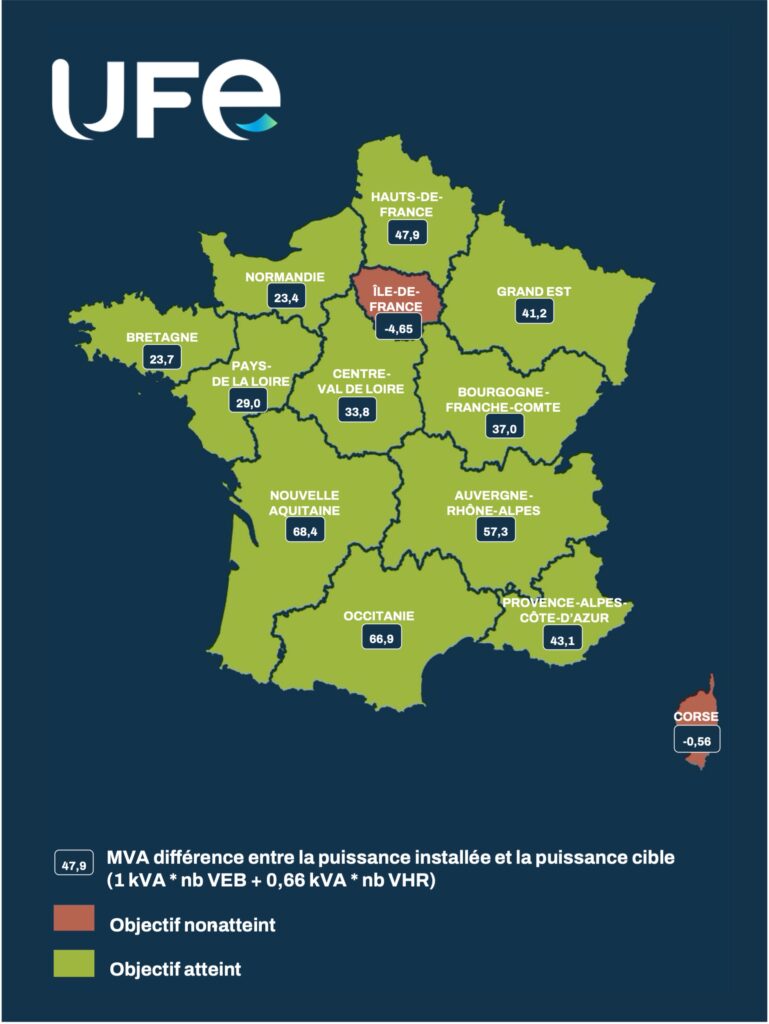
With regard to the fleet-based target, the European Commission aims for a ratio of 12/1 calculated with an average power per load point of approx. 11kW. But in France, the average power output of a charging station is 23 kW. Therefore, when applying this figure to France, taking into account the current power output of the public charging stations deployed, there would already be twice as much power available as required in the AFIR. According to UFE’s projections, in France, only two regions (i.e. Ile-de-France and Corsica) do not currently fulfil the level of capacity-based targets required without however lagging far behind. Furthermore, UFE believes that there is a bias in the Commission’s analysis because it proposes a reasoning in terms of kW used (with a consumption evenly distributed during the year) which does not allow to reply to peak demand. Indeed, UFE would like to underline that the deployment of charging infrastructure should follow a logic of coverage of recharging needs at peak times. By contrast, the methodology proposed in the AFIR seeks an average coverage of the recharging needs when it should consider the actual power delivered by the recharging stations.
The power ratios of 1kW per battery-electric vehicle (BEV) and 0.66kW per plug-in hybrid vehicle (PHEV) would currently be reached by 26 Member States out of 27. This illustrates the lack of ambition.
UFE strongly believes that hydrogen should be used in the heavy transport segment where it is more cost-efficient and where direct electrification is not feasible.
UFE agrees that measures are needed to facilitate the experience of EV consumers, however some changes are needed in the Commission’s proposal in art. 5.2. UFE is particularly concerned about the differentiation made in terms of payment methods between the charging stations according to their power output. We disagree with the Commission’s approach: charging stations with a power output equal to or greater than 50kW should be able to opt for devices using an internet connection (such as QR code) just like those below 50kW.
Indeed, while it is key to ensure that EV users will be able to pay in an easy manner when recharging their vehicles across Europe, it should be noted that payment methods evolve quickly. Therefore, assuming a payment option without leaving room for potential technological developments could lead to the necessity to revise the regulation shortly.
Furthermore, UFE is strongly concerned over the retroactive effect of the provision requiring operators of recharging points to accept electronic payments through terminals and devices used for payment services. Indeed, applying the obligation to existing charging points will bring high and disproportioned compliance cost and might lead, in some cases, to the full replacement of the installation.
UFE supports setting an obligation of digitally-connected and smart charging capable recharging points in the AFIR but has strong concerns over its retroactive application. The current wording allows the obligation to apply both to new and existing charging points.
UFE is supportive of the obligation regarding non-discriminatory access to battery-related data set in art. 20a.2 of the revision of the Renewable Energy Directive. Without a non-discriminatory access to data, car manufacturers may foreclose smart mobility related markets and then limit the potential of flexibility linked to EVs for instance.
The AFIR has set an obligation of minimum onshore electricity supply for maritime ports by 2030, while the FuelEU Maritime Initiative requires ships to be connected to these infrastructures by the same date (art. 5). This is inconsistent and would lead to timeline issues.
Map 1: France’s current level of achievement of the requirements set in the current Directive 2014/94/EU
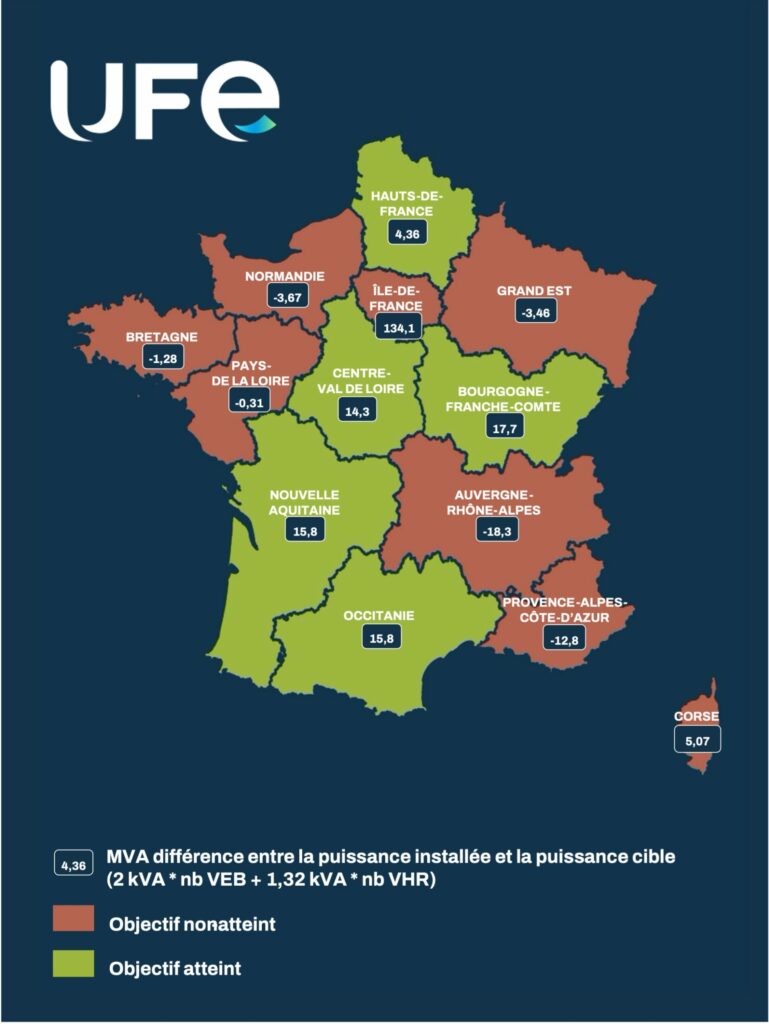
Map 2: Projection of the fleet-based targets proposed in the new Regulation on the deployment of alternative fuels infrastructure (AFIR) to France
02 February 2024

10 January 2024